Description
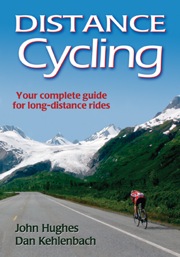
Century, brevet, double century, bicycle tour, randonnee, this book covers them all. Distance Cycling is the comprehensive guide to planning, training, equipment, nutrition and riding long-distance events.
John Hughes, distance cycling great and endurance cycling coach for 20 years, teams up with sport science expert and coach Dan Kehlenbach to cover the sport from every angle. Hughes and Kehlenbach are your personal coaches combining hands-on experience and sport science, including the latest research on training and conditioning, to cover the six success factors for endurance cycling:
- Planning—Self-assessment, goal setting, and season planning.
- Training—Aerobic, strength and flexibility workouts for baseline conditioning and specific event training.
- Nutrition—Good nutrition for cyclists year-round, nourishment before an event, and fuel during the ride and for recovery.
- Equipment—Bike selection and fit, clothing, tools and other accessories, and bike maintenance before and during rides.
- Technique—Safety, cycling economy, group riding, pacing during events and dealing with problems like flat tires.
- Mental skills—Relaxation and visualization techniques and dealing with potential hard times during a ride.
The book includes:
- Baseline conditioning—to prepare you for training for a century and other events.
- Century training—8- and 15-week training plans for a century and a 200 km brevet.
- Advanced training—for several centuries or 200 km rides in a season and for a 300 km brevet and double century.
- Weekend touring—self-supported and organized two- and three-day tours.
- Extended touring—self-supported and organized tours of a week or more and 400 and 600 km brevets.
- Riding tips—advice from 11 noted endurance cyclists.
- Safety tips—recommendations in each chapter to keep you upright and healthy.
Before you ride, read this book. As the ultimate guide for the ultimate sport, Distance Cycling will help you ride longer, stronger, and more comfortably in every event.
[ Description
Table of Contents
Authors
Reviews
Excerpt
Order the Book ]
More information Human Kinetics
|
Buy
Order a copy of Distance Cycling
Excerpt
Early Training
If you haven’t been working out regularly, then your body needs at least two months of baseline conditioning to prepare it for an event-specific training program, whether it’s an 8-week or a 15-week program. Kyle and Erika are characters used to illustrate the training programs. Kyle’s century is six months away, and he’s eager to start. He plans to do 8 weeks of preliminary conditioning and then the 15-week century training program in chapter 6. Erika ia a runner and plans to do the 8-week century training program. Read more
Review
By Ken Bonner.
Bonner rides about 18,000 miles (30,000 kilometers) a year. He has ridden at least 41 1200k and 44 1000k events.
- 11 concise and easy-to-read chapters covering every aspect of long-distance cycling
- Chapters are interspersed with interesting sidebars by experienced cycling coaches and long distance cyclists
- Solid theoretical information translated into essential practical application for riders of all abilities
- Photos related to resistance training, stretching and bike-fit measurements which are clear and helpful
- Excellent reference book, not just a ‘one-time-read’
|